Lieutenancy of County Tyrone
HM Lord-Lieutenant of Tyrone
Mr James Baxter QPM
James Baxter QPM is a native of County Tyrone and had served in the RUC/PSNI from 1973 until his retirement in 2003 when he held the rank of Superintendent and was District Commander in Omagh from 1997. He has served as Chairperson of the Omagh Police District Voluntary Welfare Support Group and has been actively involved in the welfare and support for police widows and disabled police officers.
He served as Clerk of Kirk Session, Newtownstewart
James Baxter QPM has served as Deputy Lieutenant of County Tyrone for 14 years. He lives in County Tyrone with his wife, Pearl, and has two adult children and four grand-children.
The Lord-Lieutenant is His Majesty’s Representative in a ceremonial capacity and he is charged with the following responsibilities:
- Royal visits – receiving members of the Royal Family at visits and helping to organise said visits;
- Honours and awards – promoting national honours and awards, organising the presentations of the British Empire Medals to local recipients, validating local nominations, supporting The King’s Awards for Enterprise and Voluntary Service;
- Military liaison – supporting the local military (Regulars, Reserves and Cadets) in conjunction with Reserve Forces’ and Cadets’ Association.
- Civic and charity support – working closely with elected representatives to pursue mutually beneficial objectives; and
- Community engagement – encouraging and supporting positive community cohesion and engagement.
The role of a Lord-Lieutenant
His Majesty’s representative
The fundamental principle concerning the office of Lord-Lieutenant is that they are His Majesty’s representative in their county, and consequently it is their first and foremost duty to uphold the dignity of the Crown. In this role Lord-Lieutenants have wide discretion in how they carry out the tasks expected of them and those they chose to undertake.
In general Lord-Lieutenants will be following the example of The King and other members of the Royal Family if they seek to promote a good atmosphere and a spirit of co-operation by the encouragement they give to voluntary service, and to benevolent organisations, and by the interest they take in the business, industrial and social life of their counties.
Lord-Lieutenants and Vice Lord-Lieutenants occasionally preside over Citizenship Ceremonies, welcoming, on behalf of the Sovereign, new citizens to the United Kingdom.
Lieutenancies are non-political; their responsibilities include the following:
- Helping to arrange official visits by members of the Royal Family
- Supporting and encouraging a wide range of voluntary and charitable activities
- Supporting local businesses and schools, and organisations delivering public services
- Playing an active role in the Honours system
- Submitting nominations for Garden Parties
- Encouraging nominations for the King’s Awards for Voluntary Service, and for Enterprise.
- Supporting the Emergency Services and the Armed Services, in particular the Reserve Forces and Cadets.
Vice Lord Lieutenant of County Tyrone
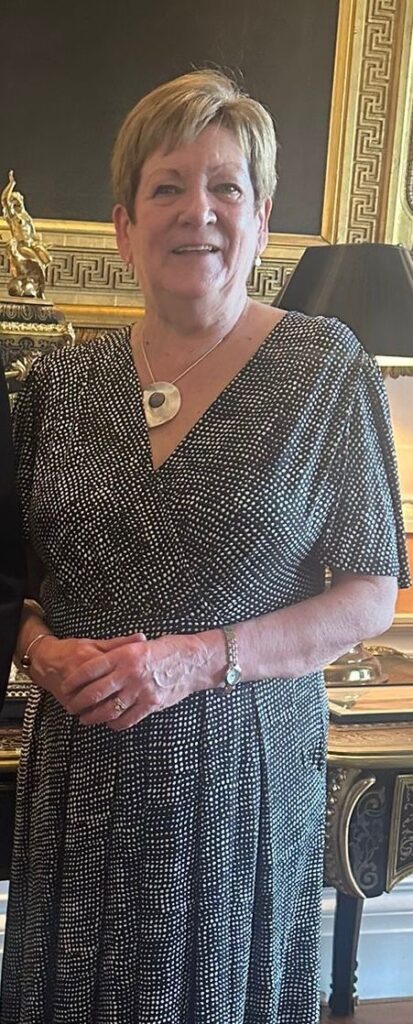
Mrs Frances Nolan, MBE
Mrs Frances Nolan, MBE, appointed DL in 2005 and has served as VLL since 2020: During her service with the police in Northern Ireland she was awarded an MBE for her services to the community and, in particular, the migrant community. On her retirement after 33 years service she took up a role with the Victims Commission and subsequently with the Parades Commission. In 2013 she travelled to Myanmar in South East Asia to play a role in a community policing project funded by the EU. At the moment she is a trustee of Brooke House Health and Wellbeing Centre that provides support to military veterans and retired police who have been physically or psychologically impacted as a result of their service.